
Under Putin’s Roof
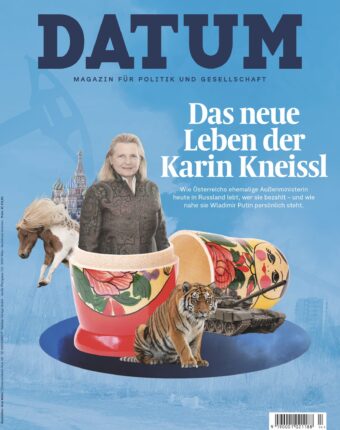
Since 2023, former Austrian foreign minister Karin Kneissl has been living in Russia, where she works as a Kremlin propagandist. Who enabled her new life? Who is funding it? And who surrounds Kneissl today?
On May 9 last year, Karin Kneissl stood in front of a Russian war memorial. The residents of the small village of Giblitsy had laid large bouquets of tulips and roses at its base. They had even erected a Soviet star made of artificial flowers in white, red and blue. It was taller than the little boy posing beside it in a Red Army uniform.
As they do everywhere in Russia, people here in the countryside, a few hundred kilometres southeast of Moscow, were commemorating the victory over Nazi Germany in what Russians call the “Great Patriotic War,” 80 years earlier. Afterwards, some of them posed for a group photograph in front of the memorial. And right there in the middle: Karin Kneissl, Austria’s former foreign minister.
Kneissl now lives in this village in the Russian provinces. Just behind the memorial stands her compact green wooden house with its veranda. Since moving in, she has even bought an additional plot of land, where she has had a stable and an enclosure built for her miniature ponies, Sumsum and Daphne.
The two animals became internationally known in September 2023. When Kneissl relocated, a Russian military aircraft, an Ilyushin plane normally used to transport tanks and soldiers, flew the ponies to Russia. By that point at the latest, it was clear that Karin Kneissl, who entered Sebastian Kurz’s first coalition government in 2017 on an FPÖ ticket, had switched sides.
You can see as much on the website of her own Institute for Geopolitics at St. Petersburg University. One of its stated tasks is to help develop solutions for “the political goals of the Russian Federation.” Kneissl is also on the payroll of several state broadcasters and was personally appointed by Vladimir Putin as an ambassador for the Amur tiger. In all of these roles, she spreads Kremlin propaganda.
How did this happen? Was Austria’s former foreign minister actively recruited? Who brought her to Russia, and who enables her privileged life there today? DATUM pursued these questions over months of reporting and uncovered new findings about Kneissl’s path to Russia and her role in Vladimir Putin’s regime.
As part of this reporting, DATUM repeatedly asked Kneissl for interviews and gave her the opportunity to respond to our findings. She declined the offers to comment.
In Russia, by contrast, Kneissl never seems to pass up a microphone. She appears in countless television programs and rarely has a kind word left for her former homeland. Recently, she compared Austrians to “hyenas.” One of her recurring lines is that it is “no coincidence that Hitler came from Austria.” Lately, Kneissl has also made repeated appearances on the television show of Vladimir Solovyov, one of the Kremlin’s most strident propagandists. He has argued that Russia should march into European capitals and must “liberate Vienna again.” Two months later, Kneissl was sitting in his studio explaining why Europeans were the “real warmongers.”
This follows a familiar Russian playbook, one the European Parliament has also warned about. Disinformation is meant to sow mistrust in Western governments and deepen divisions within society. Russia also deploys former senior Western politicians for this purpose, according to a 2022 parliamentary report. It explicitly names Gerhard Schröder – and Karin Kneissl.
But Kneissl’s position in Putin’s Russia is exceptional. She is by far the most senior Western politician to have emigrated there. And she does not merely disseminate propaganda, she embodies it. Russian state broadcasters stage Kneissl as an exile exposing the supposed moral rot of the West to Russian audiences. And the privileges she enjoys in Russia are anything but ordinary.
“The way Kneissl is being treated is very special,” says Andrei Soldatov. He is widely regarded as the expert on the Russian intelligence services. Because of his work as an investigative journalist, he had to leave Russia years ago. The Russian Interior Ministry has since placed him on its wanted list. Even so, he continues to study the security apparatus of his former homeland.
In conversation with DATUM, Soldatov explains how Putin’s regime typically deals with prominent foreigners. Russia does sometimes take in disgraced or deposed politicians, former Syrian ruler Bashar al-Assad or former Ukrainian president Viktor Yanukovych, for example. But it does so cautiously. “The state doesn’t really trust them,” Soldatov says. As a result, they can never move around the country entirely freely, are rarely visible in public, and usually appear only when the government allows or wants them to.
But with Kneissl, Soldatov says, it’s completely different: “I think it’s a very unique treatment. I never heard of anything like that before, to be honest. Just look at the institutions she has become attached to, they are genuinely high-profile in Russia.”
St. Petersburg University, where Kneissl’s Institute for Geopolitics is based, is an institution especially close to Vladimir Putin, Soldatov says. And the fact that Putin appointed Kneissl as an ambassador for the Amur tiger is, in his view, far from some bizarre footnote. “It’s actually an animal which is supervised by the administration of the president, by Putin himself.” Soldatov’s conclusion is: “Kneissl is not only treated with respect and like a celebrity, but she is also apparently trusted.”
That is why Soldatov suspects Kneissl’s life in Russia is not being managed by a single ministry or one intelligence service. The circle of institutions involved is too prominent, and the case too sensitive. “The whole thing is supervised by Vladimir Putin, I think,” he says. That, too, would fit Putin’s tendency toward micromanagement – and his long personal connection to Kneissl.
Could that really be true? Is Putin himself shielding Kneissl and enabling her life as a celebrity in Russia?
Anyone who wants to understand Kneissl’s transformation from once-respected Middle East expert into a Kremlin propagandist has to go back many years. It is no longer possible to reconstruct precisely when her relationship with Russia first began to take shape. One trail leads to early-1990s Paris, and to Sergey Shirnov, one of Kneissl’s fellow students there. Shirnov later claimed that, at the time, he had secretly been spying for Russian intelligence, identifying possible KGB targets. Kneissl was one of the people, he told DATUM, whom he reported back to Russia as “a good target.” His notes, he said, likely ended up with the SVR, the KGB’s successor agency, because the Berlin Wall had already fallen and the Soviet Union was collapsing in Moscow.
In August 2018, Vladimir Putin traveled to the vineyards of Styria for Kneissl’s wedding. There, at the end of their dance, Kneissl dropped into a deep curtsy before him.
There were other points of contact, too. While still working as a journalist, Kneissl first encountered Vladimir Putin in 2001 during a state visit to Slovenia. In an interview with a Russian newspaper, she claims she actually spoke with him on that occasion. In 2014, she traveled to Moscow and visited the then Austrian ambassador there, Margot Klestil-Löffler. Klestil-Löffler knew Putin personally and, within Austria’s Foreign Ministry, was long considered the only person with a direct line to the Russian president. Later, Kneissl brought her into her own ministerial office as an adviser on Russia.
By that point at the latest, Kneissl’s relationship with Russia had grown closer, politically as well as personally. In 2018, she did not just invite Vladimir Putin to her wedding in Styria. That same year, she also met a man named Leonid Slutsky.
Slutsky heads the Duma’s Foreign Affairs Committee and is thus something like the chief diplomat of the Russian parliament. In that role, he travels extensively, including to Austria. He visited Kneissl in her hometown of Seibersdorf, a village of 1,600 people in Lower Austria. Two photographs survive from the visit. In one, the two pose in front of Kneissl’s stable beside one of her horses. In the other, they cuddle with Kneissl’s boxer dogs, Winston and Jacky.
In 2024, the Austrian weekly newspaper Falter reported on a dossier said to come from people with insider knowledge of the the Russian embassy. According to that dossier, Slutsky was chiefly responsible for “recruiting” Karin Kneissl for Russia. Over drinks, together with the then Turkish foreign minister, he is said to have developed a close relationship with her.
DATUM has now revealed more about this meeting between Kneissl, Slutsky and the Turkish foreign minister. According to a Western security official who spoke to DATUM on the condition of anonymity there was yet another person at that gathering: Maria Khodynskaya, Slutsky’s lover. According to reporting by the investigative outlet The Insider, Khodynskaya is said to be a GRU operative who, because of her taste for expensive cars, goes by the nickname “Bentley Masha.”
Slutsky himself is also said, according to The Insider, to have ties to the GRU. Through his “Russian Peace Foundation,” he organizes trips to Russia for foreign academics, professors and other prominent figures. Their passport details and personal data were allegedly passed on to Russian military intelligence, The Insider reported. Another media outlet referred to Slutsky in this context as “the GRU’s travel agent.”
It is not clear whether Slutsky ever explicitly asked Kneissl to work for Russia. But according to the Russian political scientist Ekaterina Shulmann, that may not even have been necessary. Shulmann worked for years in the Duma, later taught in Moscow, and now lives in Berlin after being forced to leave Russia. As early as 2023, in an interview with the Austrian Press Agency APA, she said she found it astonishing that Austria had made a Russian agent its foreign minister.
When Shulmann uses the word “agent,” she does not necessarily mean someone with a codename and a formal contract with an intelligence service. She distinguishes between “official” and “unofficial” agents. The latter often do not even realize they are working in the interests of Russian intelligence. In conversation with DATUM, Shulmann says: “There are people who are instrumentalized or exploited by foreign powers and their intelligence services without knowing it. To end up in such a situation, you do not have to be stupid.”
People are especially vulnerable to such influence, she says, during moments of personal or professional crisis: “Especially when you are under financial pressure, have many animals to feed, and no longer really know how to go on.”
That is clearly a reference to the period after Kneissl’s political career in Austria came to an end. After the Ibiza video brought down the coalition government in May 2019, Kneissl lost her post as foreign minister. By then she had already fallen out with the FPÖ. And because of her dance with Putin at her wedding – and probably because of her ties to the Freedom Party as well – no other Austrian party had any interest in securing her a job. As a former minister with a pro-Russian reputation, she found it difficult to slip back into to her old role as a geopolitical expert. In a Russian documentary, Kneissl complains of financial worries and says she felt ostracized: “There was a de facto employment ban for me.”
Her private life was in no better shape. Several of her animals died after she left office. Soon after, her marriage also fell apart. She also claims she received anonymous threats and was spat at in the street. She told the Russian state broadcaster RT: “Things were thrown into my mailbox. What was written inside? ‘The Russian sow must hang. Putin whore, they should slash you and bury you alive.’”
In 2020, Kneissl finally left Austria and moved to France. But she did not manage to settle there either. She told a Russian state broadcaster that French domestic intelligence had contacted the owners of the house she was renting, questioned them and advised them to evict her. DATUM asked the French Interior Ministry for comment, but received no response. Kneissl says she then spent weeks without a roof over her head.
“When, in such a situation, someone appears who shows understanding, and has the money and the ability to transport your animals,” Shulmann says, “then the temptation is great.” Today, thanks to Russia’s efforts, Kneissl lives with her horses, dogs and cats in a small place 380 kilometers from Moscow. There, in Giblitsy, Russia still looks a little like it does in Tolstoy’s novels: a few gravel roads lined with colorful wooden houses, with meadows and woods all around. And it is here that one begins to understand the role Vladimir Putin himself may play in this story.
Take that group photograph in front of the war memorial on May 9 last year. One man immediately stands out. He is stockily built, wears a thick moustache, and has a striking mole on his left cheek. Whenever Kneissl appears in public in her district, he is usually by her side. Sometimes he accompanies her in a suit and tie, sometimes just in a polo shirt. In the memorial photograph from Giblitsy, Kneissl and he stand side by side. He even personally oversaw the construction of her new green wooden house.
Who is he? In a documentary by the Russian state broadcaster RT about Kneissl’s life in Russia, she describes him as “my neighbor.” The two are shown strolling through the village streets while he holds Kneissl’s boxer on a leash. In local Russian media he appears under the name Vladimir Sergeyevich Trubochkin. He is the head of the municipality in Kneissl’s new home. And he is also a former KGB man. In the early 1990s, he completed “advanced courses” in “military counterintelligence.” Several Russian media reports confirm this.
Kneissl herself also appears to know about Trubochkin’s intelligence background. In her latest book, Requiem for Europe, which has so far been published only in Russian, she writes that in the summer of 2023 she spoke with the “head of a small rural municipality” about his time in the KGB.
But Trubochkin is not just a former intelligence officer, like Vladimir Putin himself. By presidential decree, he was also appointed to the “Council under the President for the Development of Local Self-Government.” Intelligence expert Soldatov says: “This council is directly under Putin, which means that this man has theoretically access to Putin.”
And Trubochkin is not the only figure from Putin’s orbit who keeps appearing around Kneissl. One man in particular is especially close to the Kremlin chief: former education minister and current presidential adviser Andrei Fursenko.
Kneissl’s acquaintance with Fursenko dates back – like her acquaintance with Slutsky – to her own time as foreign minister. In 2019, the two played leading roles in the founding of the “Sochi Dialogue,” a cultural exchange initiative between Austria and Russia. Through this initiative, Fursenko financed and organized one of Kneissl’s first major public appearances after leaving office: in Moscow, she gave a reading from her children’s book about Prince Eugene while Fursenko delivered a speech in her honor.
Their paths later crossed again, at least indirectly, after Kneissl shifted the center of her life to Russia. The closest associate at Kneissl’s new institute boasts in his CV of recommendations from Fursenko. At the same time, Kneissl spent more than nine months living in an exclusive residential complex on an island in St. Petersburg. Fursenko’s brother also owns property in that same gated development.
The dossier DATUM received from a Western intelligence service contains additional information about this phase. According to it, an entire group of people from the state apparatus worked to “integrate” Kneissl into Russian society: university staff, representatives of media organizations, and real-estate advisers. Finding her a place to live was reportedly especially difficult. Behind her back, those involved are said to have complained about Kneissl’s high standards. She was apparently shown more than twenty properties before she accepted one.
According to information from a Western intelligence service, an employee in Fursenko’s Sochi office also looks after Kneissl whenever she is in Moscow. She organizes concert and theatre tickets, books restaurant tables, and makes sure Kneissl otherwise has whatever she needs.
Her contacts to men from Putin’s inner orbit, this carefully managed integration into Russian society – all of these are traces suggesting that Karin Kneissl is under Putin’s personal protection.
That impression is reinforced by a private letter in DATUM’s possession, signed with the name Karin Kneissl. The addressee: His Excellency Ambassador Anton Vaino. For the past ten years, he has served as Putin’s chief of staff, head of the presidential administration, and thus one of the most powerful men in Russia.
In this letter, Kneissl writes: “I am profoundly grateful for all the immeasurable assistance provided in organising my relocation to St. Petersburg via the Khmeimim Air Base. My animals and myself were welcomed like close relatives.” In other words: this is a thank-you letter for the pony transport by military aircraft in September 2023.
Kneissl becomes even more explicit: “In expressing my heartfelt appreciation for the Presidential Executive Office for planning this operation from behind the scenes, as well as the Ministry of Defence and the Khmeimim Air Base leadership I would also like to highlight the personal efforts of the Deputy Chief of Mission Mr Maxim Romanov and the head of the ‘Roslivan’ NPO Mr Mohammad Nasreddine.”
So Kneissl is explicitly thanking Putin’s office for discreetly organizing her elaborate relocation and then names two further men whom she says played a key role in making the operation a success: the Russian deputy ambassador in Beirut and the head of the Lebanese-Russian coordination office Roslivan. Both of them, Kneissl writes in a somewhat grand closing flourish, deserved an order of merit.
Kneissl had already decided while in France that she wanted to emigrate to Russia. Because she had accepted a supervisory board position at the oil company Rosneft in 2021, money was waiting for her there. But because of sanctions, those funds could no longer be transferred into the EU. According to DATUM’s reporting, the sum amounted to half a million dollars, around 460,000 euros at the time. By then, at the latest, Kneissl must have realized that she could not earn money in Russia while continuing to live in Europe. She first moved to Lebanon and then, together with her ponies, traveled via a Russian military base to Russia.
Kneissl herself did not want to comment on the letter. DATUM checked the names, dates and wording it contains. The details match information from numerous other sources – from the names of those who helped with her move to Anton Vaino’s birthday, which Kneissl also used the letter to congratulate him on.
The source of the letter is a person working for a Western intelligence service. That source pointed out that the closeness to Putin and his office reflected in the document made any central coordinating body for Kneissl’s affairs unnecessary: “Everybody knows she danced with the big guy.” The “big guy,” of course, means Putin. Because Kneissl danced with him at her wedding, everyone knows, that she is under his krysha, literally, under his “roof.”
Figuratively, krysha means something like the protective hand of a powerful patron. And in Putin’s corrupt and authoritarian Russia, that is what you need in order to survive. Many people can provide such krysha: powerful figures in business or in the state apparatus. But the biggest, most stable roof is Putin’s own. And it is under that roof that Karin Kneissl has built her new life.
From the outside, at least, it appears to be a comfortable one. In the past year alone, according to Russian leaks, Kneissl earned the equivalent of around 220,000 euros. That is more than 18,000 euros a month, more than her salary as a minister in Austria, earned through work at Russian universities and state media companies. One of her clients is TV Novosti, the company behind the EU-banned broadcaster Russia Today.
In addition, she has three bank accounts in Russia on which, as of 2024, she had parked a low six-figure sum in euros. Two of those banks are themselves on the EU sanctions list. Yet even all this is only one fragment of her new life in Russia.
And Kneissl herself seems to know exactly to whom she owes that life. In a Russian documentary, a Putin calendar can be seen hanging in her living room. Beside it hangs a photo of Putin, Austrian president Alexander Van der Bellen, and Kneissl herself. Also framed and displayed on the windowsill is a picture from her wedding. Her husband can no longer be seen in it. She seems to have cut him out after the divorce. What remains is a photograph of Karin Kneissl in her wedding dress – standing beside Vladimir Putin.
Sie können die gesamte Ausgabe, in der dieser Artikel erschien, als ePaper kaufen:
Diese Ausgabe als ePaper für € 6,00 kaufen